
Project Overview
As the sole Product Designer, I explored WPP’s Self Driving Campaign Manager: an internal concept for forecasting future advertising-budget allocations from historical campaign data. The engagement focused on discovery, workflow definition and an alpha wireframe prototype, followed by a visual concept. The product did not progress to a full launch.
The concept addressed a planning decision rather than simply presenting campaign charts. Users needed to choose relevant historical evidence, understand its limitations and use it to discuss a future allocation. My focus was the experience surrounding that decision: how to establish a campaign context, inspect the available inputs and communicate the recommendation. Keeping the work at alpha stage allowed the team to evaluate the interaction model before committing to a complete product.
The Challenge
Media planners needed to identify relevant historical campaigns, review data quality and interpret potential allocations across markets and channels. Spreadsheet-heavy analysis made the process difficult to standardise. The concept needed enough detail for meaningful feedback while remaining practical within alpha-stage time, budget and testing constraints.
A forecast can appear convincing even when its inputs are incomplete or poorly matched to the next campaign. This made data selection and explanation central UX concerns. Users needed to retain context across client, market, channel and time period, while recognising anomalies before accepting an output. The design challenge was to provide enough guidance for less familiar users without turning a specialist planning workflow into an overly restrictive sequence for experienced media managers.
Research & Insights
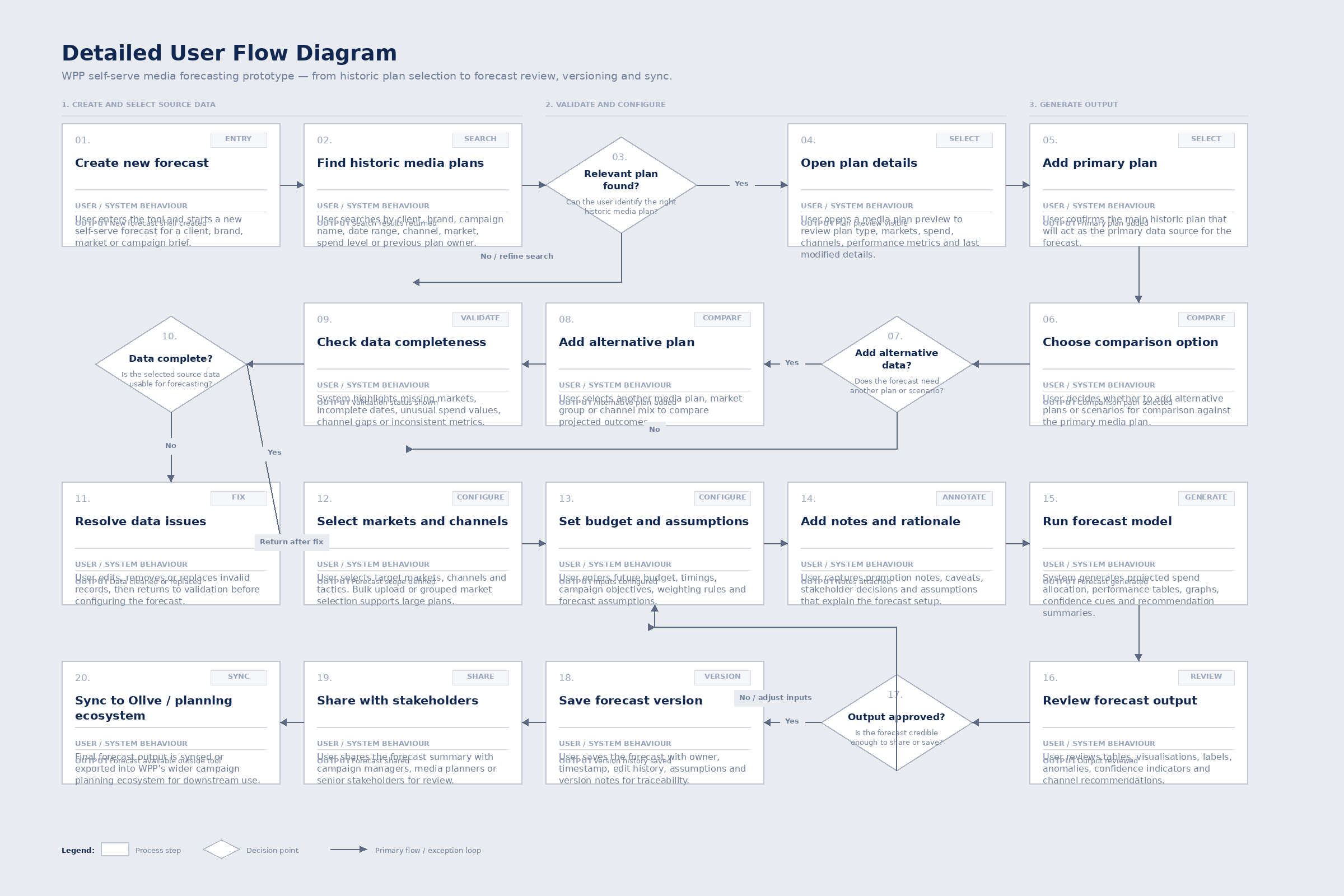
I used focused sessions with the Product Owner and internal campaign stakeholders to understand the inputs, assumptions and decisions behind a forecast. Mapping the journey exposed where users needed context: selecting a valid baseline, interpreting anomalous data and understanding how those conditions affected confidence in the output.
The research connected manual planning activities to the decisions the concept needed to support. Historical plans were not interchangeable: their market, timing and channel coverage affected their relevance. Stakeholder sessions also surfaced the importance of explaining a forecast to colleagues or clients. These insights shifted the emphasis from producing a number to making the evidence behind that number inspectable, with data quality and decision confidence treated as connected parts of the journey.
Design Decisions
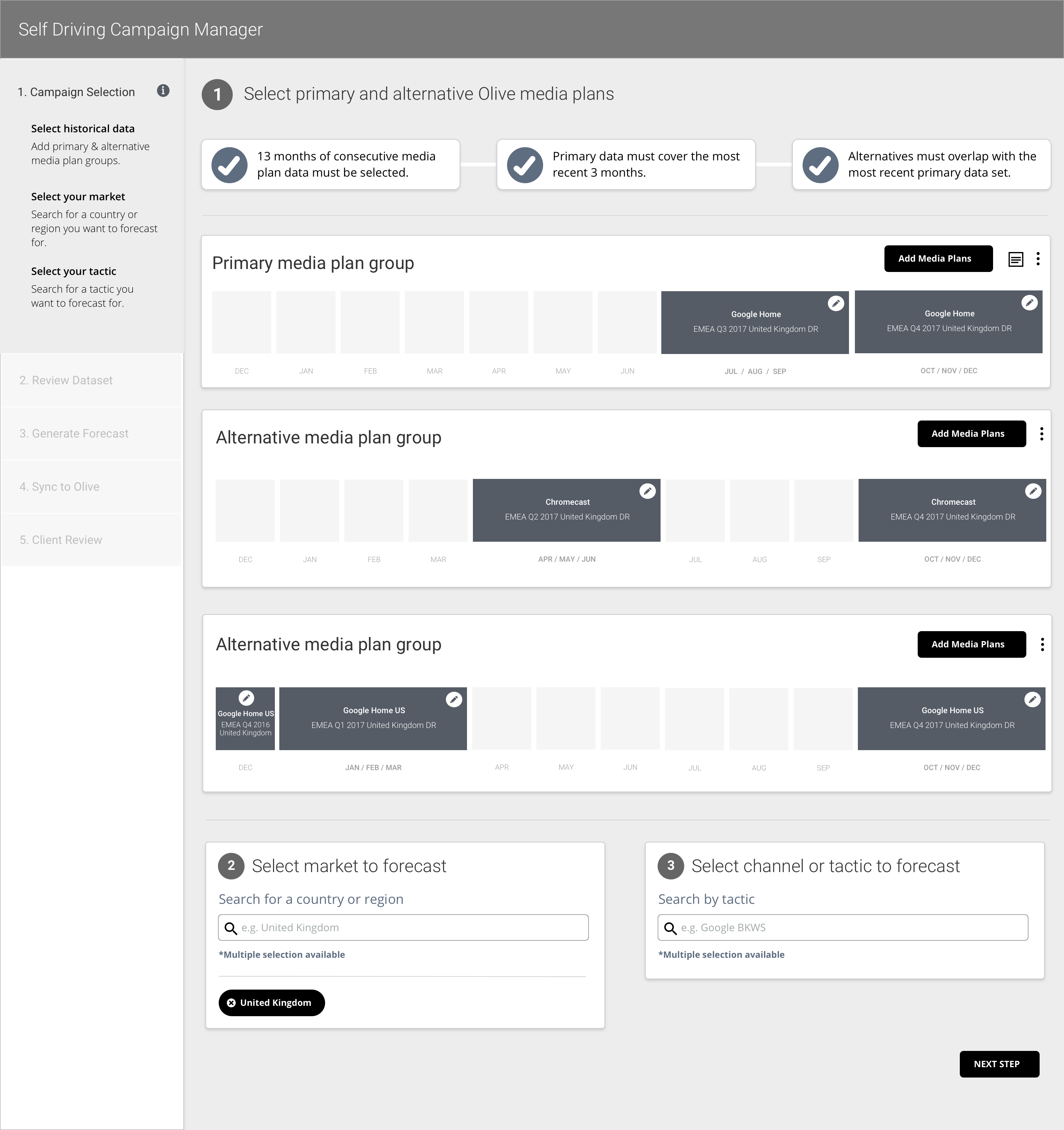
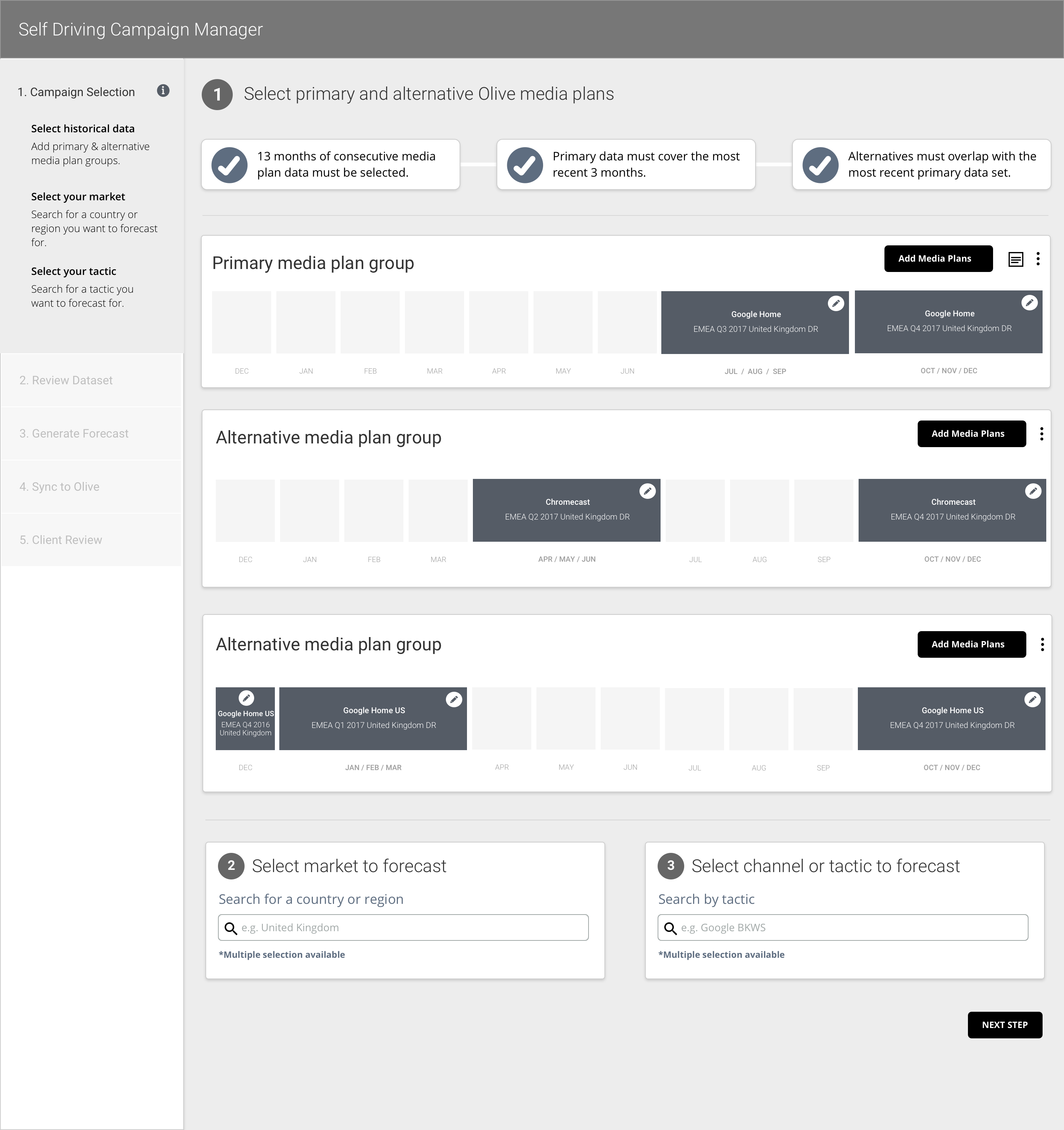
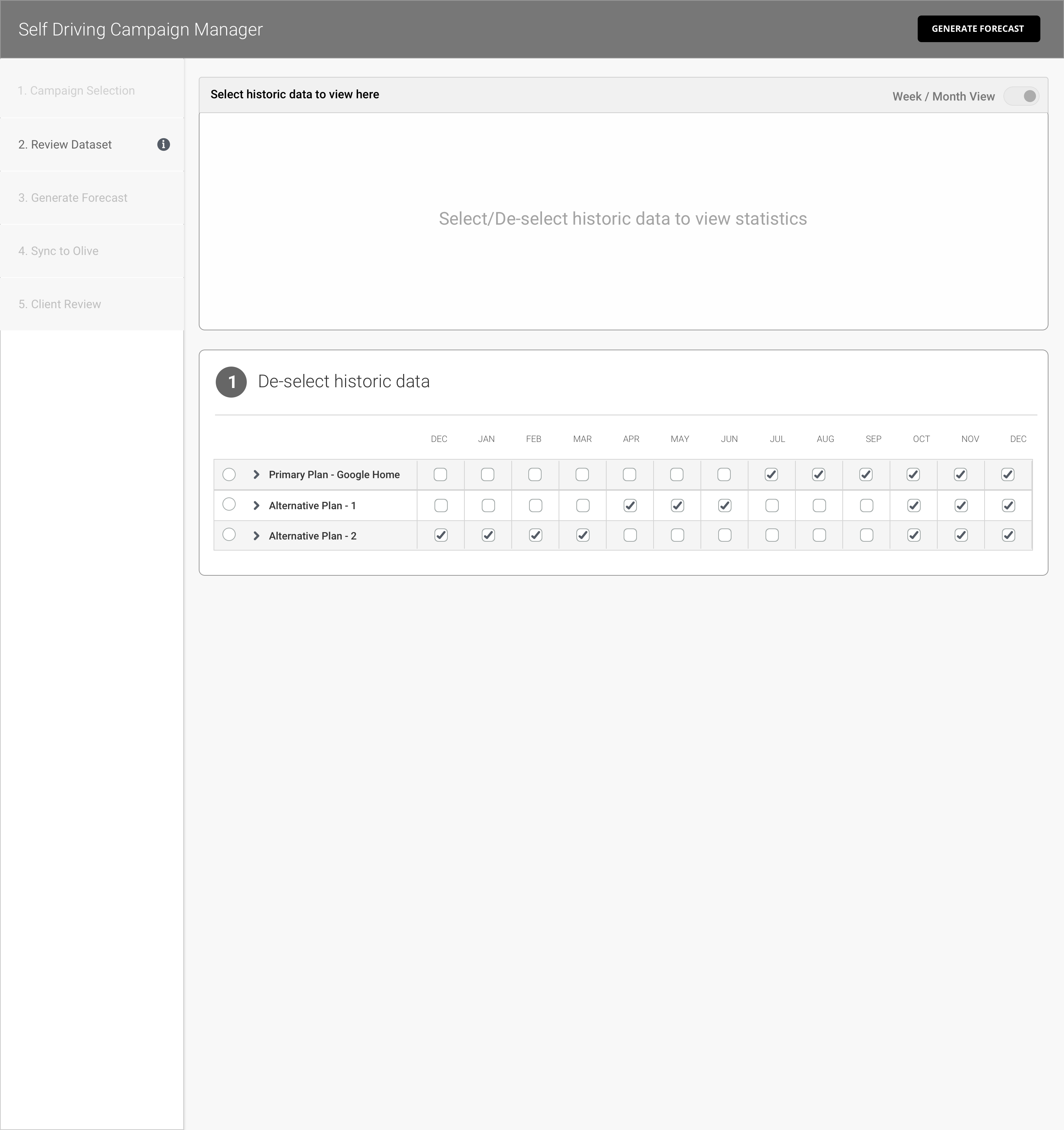
I structured the journey into campaign selection, future-budget inputs, data review and forecast summary. Progress signposting helped users retain context, while data-quality information and anomaly messages made assumptions visible. The recommendation was given greater prominence than supporting detail so the summary could support a decision.
Primary and alternative media-plan groups were visually separated so users could compare their roles without losing the wider campaign context. Timeline-style cards made coverage easier to inspect, and validation messages explained requirements before forecast generation. Editing plans through supporting overlays preserved the user's place in the setup flow. These decisions used progressive disclosure to keep each screen focused while retaining enough context to understand why a particular input was needed.
The Solution
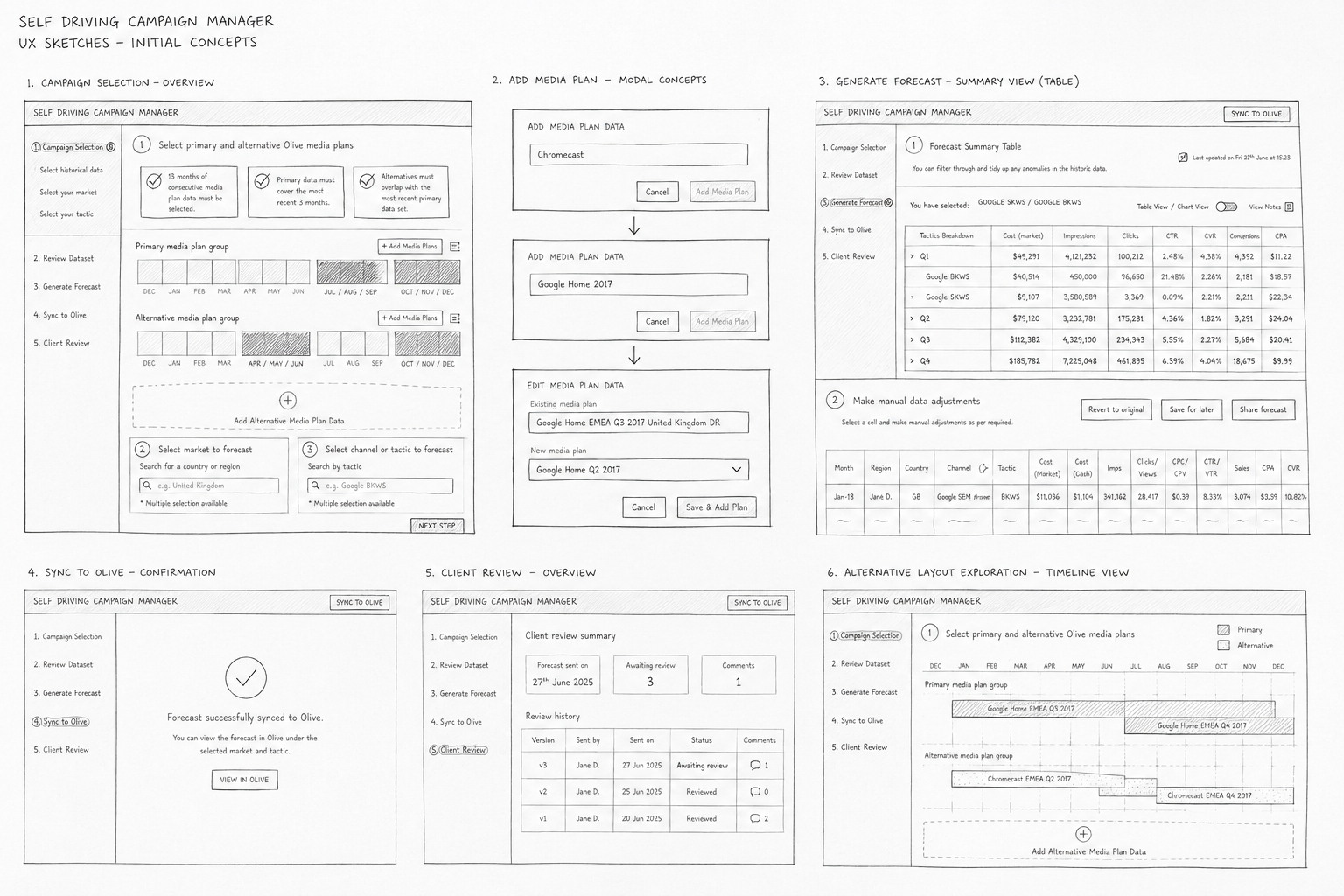
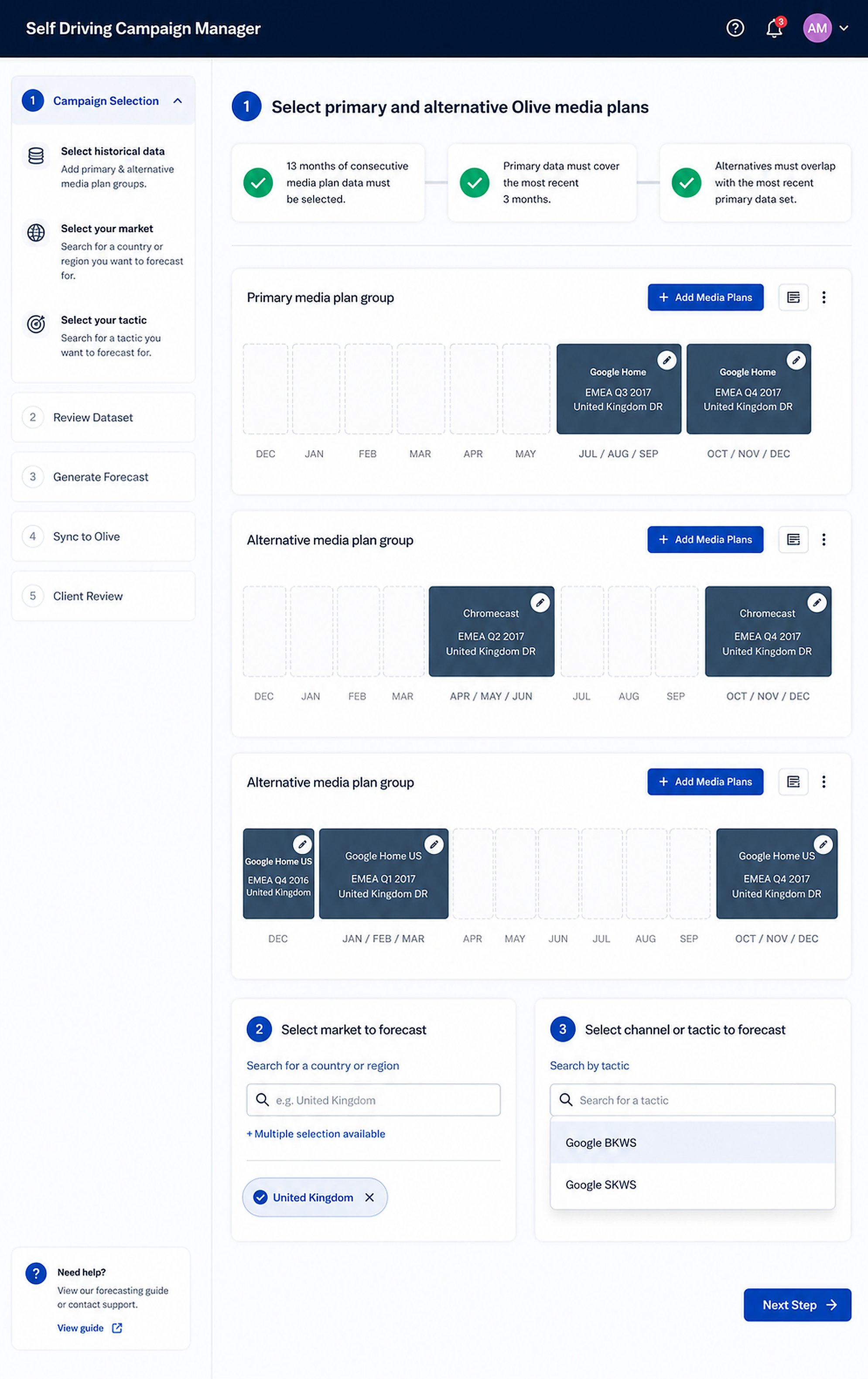
The wireframe prototype connected data selection, media-plan comparison and forecast review in a guided workflow. I created low-fidelity components aligned with WPP’s existing patterns, then explored a visual concept to communicate how the product might develop. The polished screens represent a concept rather than a launched service.
The prototype connected setup, data review and output through a guided sequence. Forecast tables, manual adjustment controls, notes and sharing actions explored how users might inspect and discuss a recommendation rather than accept it without question. Supporting chart and table views offered different ways to read the same evidence. The visual concept developed this direction further, but its purpose was to communicate a possible product experience; it did not establish a production-ready forecasting model.
Validation & Iteration
Testing involved ten participants: seven media-planning managers and three people outside the domain. Feedback highlighted ambiguous campaign criteria, weak transition cues and unclear forecast confidence. I refined guidance, severity messaging, summary hierarchy and confirmation states before saving or exporting.
The domain participants helped assess whether the terminology and workflow reflected real planning tasks, while the less familiar participants exposed places where the journey relied on unstated knowledge. This distinction matters when interpreting feedback: ease of navigation and specialist decision quality are different questions. The changes focused on clearer criteria, transition cues and forecast context. Later validation should use representative campaign data to test the model and the interface together.
Delivery & Collaboration
I worked directly with the Product Owner and internal campaign stakeholders, preparing specific questions to make limited stakeholder time useful. The prototype and visual exploration supported discussion of workflow feasibility and the case for further investment, rather than a production handoff or launch.
Working as the sole designer required focused use of stakeholder time. Specific questions and visible flows helped turn broad product ambitions into decisions about sequence, inputs and scope. Low-fidelity components made iteration practical while keeping the discussion centred on behaviour. The resulting prototype served as a shared exploration tool, giving the Product Owner and campaign stakeholders something concrete to evaluate before deciding whether to invest in a fuller implementation.
Outcomes & Impact
The tangible outcome was a testable alpha journey and a clearer visual direction. The source includes projected efficiency and confidence improvements; those are potential benefits, not verified post-launch results. The concept established where further data-quality, forecasting and workflow validation would be needed.
The alpha's value was in making an emerging product idea testable. It clarified the steps required to prepare a forecast, identified points of uncertainty and provided an interface direction for further investigation. Potential efficiency gains should be assessed in a future operational pilot, alongside the quality and defensibility of planning decisions. Faster generation alone would not demonstrate a better outcome if users could not explain the recommendation or identify unsuitable inputs.
Reflection & Next Steps
For a forecasting tool, trust depends on showing assumptions and uncertainty as clearly as recommendations. A next phase would validate the forecasting model and representative campaign data alongside the interface, then measure planning effort and decision confidence with domain users.
The work reinforced that explainability is part of the core workflow for decision-support products. Assumptions, anomalies and available adjustments need to be understandable before users rely on the output. The next step would be a domain-led pilot comparing the proposed journey with existing planning practice. Evaluation should examine the effort involved, how participants interpret uncertainty, and whether they can communicate a recommendation with a clear account of its supporting evidence.